


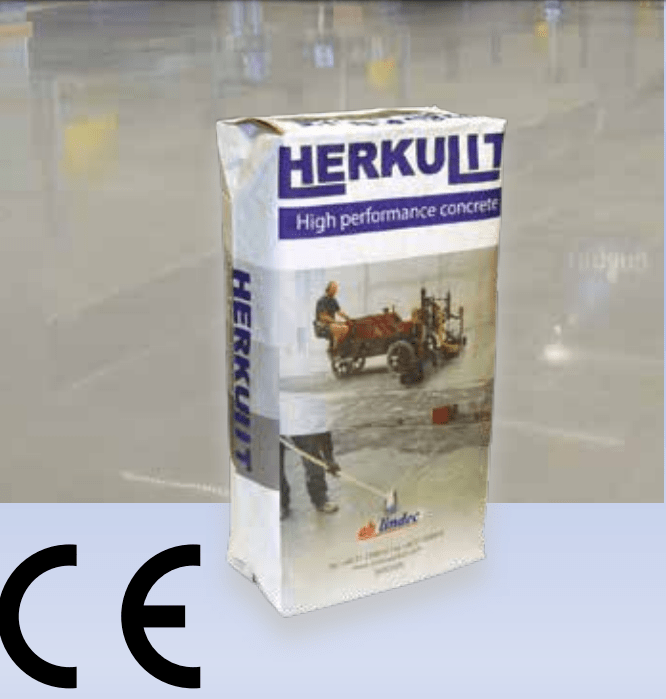
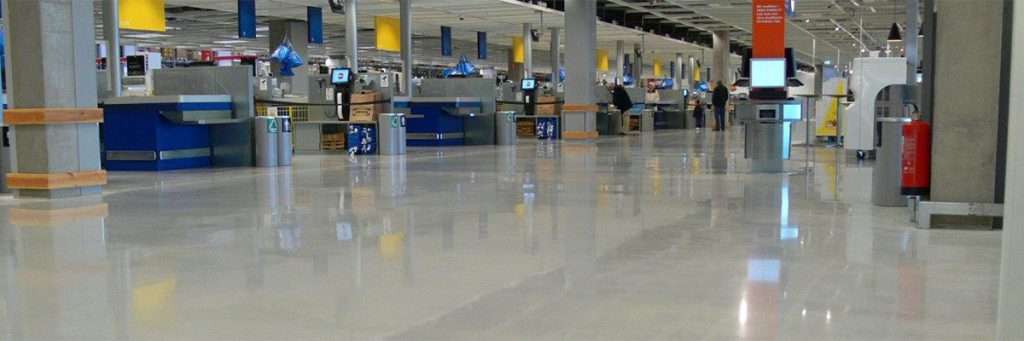
Herkulit S-Top is mainly used on floors where there is a high level of requirements for durability, easy maintenance, good long-term economy, and a rustic appearance.
Herkulit® S-Top is used in industry, shopping centers, public premises, galleries, offices and parking garages.
Herkulit® S-Top is a natural, environmentally-friendly material. The material is diffusion open, cannot be damaged by water and is also antistatic. Installation does not require the use of environmentally hazardous additives.
Herkulit S-Top is an 8-30 mm surface course that binds to both old and newly hardened concrete. The wear course is designed to provide problem-free functionality in extreme industrial environments or in premises where hygiene is important. This type of floor normally lasts for more than 30 years even in locations heavily used by vehicles such as trucks.
Floors in old premises are renewed by applying Herkulit® S-Top. And can be used to renew an entirely worn-out floor or to upgrade a premises.
In both cases a floor refurbishment is a qualitative, practical and cost-effective alternative to removing the existing concrete floor.
Herkulit S-Top prevents chlorides and other harmful substances from permeating into the sub concrete. (Herkulit® S-Top acts as an environmentally friendly protection for the sub concrete.) Repairs to the existing concrete surfaces stops carbonation and decomposition of the structural concrete and are frost resistant.
The installation should be carried out by an experienced, qualified contractor. A surface course that is laid on a subfloor with no seams produces a perfect, problem-free floor covering. This combination reduces the need for seams in the floor by up to 80% compared with ordinary concrete flooring, and thereby also reduces the cost of repairs and maintenance in the future.
A seam-free concrete base can be created by adapting the concrete and the work in order to optimize the function of the concrete floor, instead of compromising due to the design of the building and the installation technique.
This is made possible by laying the subfloor at an early stage in the construction process and laying the surface in an indoor environment at the end of the process. This also guarantees tolerances and surface finish, both of which are directly governed by the environment in which they are poured and laid, saving both time and money.
Project planning instructions
Carrying out the work:
The work is divided into five main elements
- Blasting / milling
- Laying
- Trowell and finishing
- Curing
- Treatments
Conditions at the workplace:
When laying Herkulit® S-Top temperature should be at least +10°C at the surface of the concrete, and be free of drips and draughts.
Technical data:
- The following properties are typical average values and should not beregarded as minimum or characteristic values. All properties are at +20°C.
- Applied type Herkulit S-Top
- Compression strength in N/mm² after 28 days 75-110 N/mm²
- Tensile strength in bending in N/mm² after 28 days 9-12 N/mm²
- Wear strength after DIN 52108 Bohme – value in cm³/50 cm² <4*
- *Applies to Dynagrip aggregate
Description:
To achieve a satisfactory result when laying Herkulit® S-Top it is important that the concrete base is of good quality. The surface and structure of the concrete base is crucially important for the adhesion of the top layer. If there is any doubt as to whether the concrete base can meet the set requirements, a site test or a tensile strength test should be carried out, or if necessary, cores should be drilled out for closer analysis.
Requirements:
To ensure that Herkulit® S-Top can function optimally, the concrete base must comply with the following requirements: Adhesion: The tensile strength in the surface should be 1.5 MPa (15 kg/cm²) at the time of laying Herkulit® S-Top.
The surface: The surface should be free of slurry and cement film as well as impurities.
Flatness: The concrete base should be sufficiently flat that the thickness of
Herkulit® S-Top can be kept within the given margins.
- Aggregate 1-3 mm 8-12 mm
- Aggregate 1-4 mm 12-15 mm
- Aggregate 1-8 mm 15-30 mm
Guidance:
If the concrete base has a tensile strength of at least 35 N/mm² and is otherwise of good quality and free of impurities, it can be expected that the above requirements for adhesion will be met after blasting, or alternatively milling and cleaning the surface.
For new production:
Lay the concrete base using vibration to achieve a level and homogenous surface. Do not overwork the surface so that slurry appears on the surface of the concrete base. The slump of concrete and working methods directly affects surface tensile strength.
Wean using higher concrete slump you need to increase concrete quality. Any inclines towards drains must be executed in the concrete base before laying the top layer. The concrete base should be sufficiently flat that the Herkulit® S-Top is within the acceptable tolerances.
The surface should be prepared for blasting/milling (fine trowelled surface)
Never use wax or solvent-based moisture-curing on the concrete base.
All details of the floor structure should be decided. Before laying the concrete base. The concrete base must be laid on a flat and stable base course that will have to withstand the loads that are conveyed to it.
Levelling:
The surface around seams and cracks must be as level as possible when laying Herkulit® S-Top.
Seams: Herkulit® S-Top floor binds at the concrete base and does not require joints.
Seams in the concrete base:
We recommend sawing joints in Herkulit® S-Top coverings over old seams that are moving. Any cracks that are moving in the concrete base should be injected.
Blasting/milling:
The surface structure should be equivalent to a minimum of 2 mm/max 30 % of the thickness of the top layer, when milling, otherwise blast the surface. The surface should be free of slurry and cement film. Blasting/milling should be carried out over the entire surface, as well as in the vicinity of walls, pillars etc. If it is not possible for the machines to access right to the edges, this is done by hand. Before milling/blasting the existing concrete base any cracks, rising edges, old seams etc. should be repaired. After milling the concrete should be cleaned thoroughly by means of vacuuming, high pressure flushing etc., depending on the cleanliness and structure of the surface.
Applying water and covering:
Water should be applied. Depending on the temperature conditions and the density of the concrete it is recommended that application of water should commence 8-24 hours before laying the primer. Uncover the surface concurrently with pouring. If there is any free-standing water, it must be vacuum dewatered before priming.
Color:
Basic color: light grey. Pigments are added for other colors.
Choice of colors:
There is a free choice of colors for Herkulit®. Take into account the fact that pigmented cement-based products cannot be compared with color codes for paint.
• Light colors should be avoided on surfaces that are frequently made dirty.
Seams, patterns: Can be sawn and filled as required
Protecting finished surfaces:
Herkulit® S-Top surfaces that are completed before the building is finished should be covered for protection and kept covered during the final installation. Herkulit® S-Top is concrete and at first it therefore absorbs both water and waterborne dirt. The covering material should be waterproof and non-coloring, e.g. waterproof board.
Surface treatment:
Natural efflorescence occurs during the initial period of use, producing a dull surface. To remove this, treat the surface immediately after removing the moisture-curing film. Use LC Rider Pad system or LC Diamond Pad system.
Cleaning:
Clean floors with soap of the Concrete Soap® type. In line with the regular cleaning the surfaces will become more liquid-repellent and acquire their finished gloss. (Refer to cleaning instructions for more information)
ab lindec® endeavours to provide correct information about technical properties and handling of its products. However, while ab lindec® has no control over the way in which the products are mixed and laid, or the conditions under which they set, ab lindec® can in no way be held responsible. ab lindec® is only responsible for the quality of the products at the time of delivery.